
Looking for psychological military science fiction? Read about the adventure of veteran Brendan Murphy as he tries to keep peace between Earth and a mysterious alien race known as the Sabia. Read the Fallen series today! I’m currently working on the fourth and final book. Please remember to leave a review once you are done. Reviews are the lifeblood of independent creators
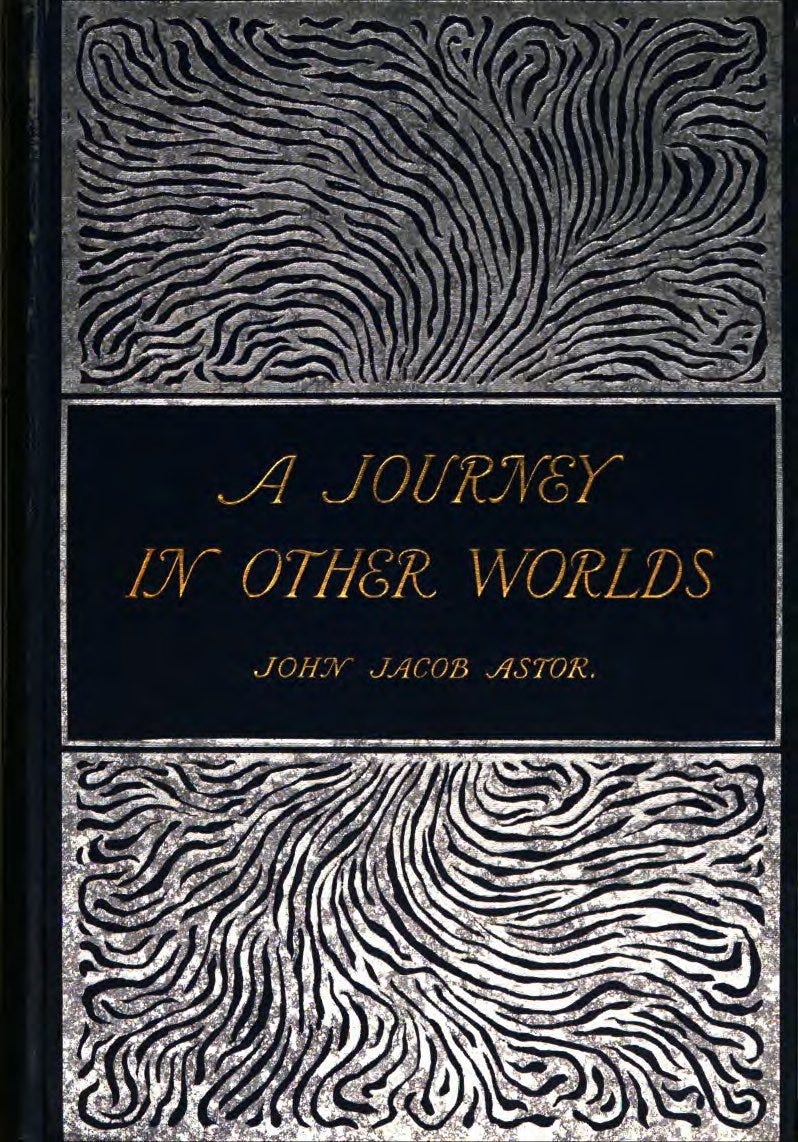
A Journey Through A Journey in Other Worlds
The Author
John Jacob Astor IV was a member of the ultra-rich Astor family and a colonel in the Spanish-American War. Of particular note, he donated the temporary service of his private yacht to the military and personally funded an artillery unit.
What most people remember him for now, though, is his death aboard the RMS Titanic. He was, in fact, the richest man to die aboard that ship. (See my Titanic in Science Fiction post for more about the ship’s role in sci-fi.) Yet, he was also a science fiction writer and inventor. In 1894, he wrote A Journey in Other Worlds: A Romance of the Future.
I won’t be doing a traditional plot synopsis, but instead will cover the science, fiction, and faith of the book.
The World
The book takes place in the year 2000. Mankind is living in an age of technological success with advancements like
Electricity from green sources like tides and winds.
Windmill-powered electric ships.
Battery powered airplanes.
High speed magnetic railways.
Color photography.
Artificial rain via rain seeding.
Medical progress raising the average age beyond 60.
The avoidance of wars via diplomatic unions.
The United States encompassing most of the Western Hemisphere as the “more progress Anglo-Saxons” expand into depopulating Hispanic areas.
Global, instant audio-visual communication through telephones.
Eradication of pests through biological controls.
Giant “marine spiders” transportation devices that walk on water.
English as the global language.
Universal education.
Global adoption of the Metric System.
Decline of religions worldwide, noted for leaving a spiritual emptiness.
While a fair amount of those things have come true, some of those have turned out to be failed predictions or dead wrong. As a testament to this book’s utopian nature, the following describes America’s political system, “It is the duty of each member of Congress to understand the conditions existing in every other member’s State or district, and the country’s interest always precedes that of party. We have a comprehensive examination system in the civil service, and every officeholder, except members of the Cabinet, retains his office while efficiently performing his duty, without regard to politics.”
The book’s plot picks up when the president of the Terrestrial Axis Straightening Company, Colonel Bearwarden, announces his plan to realign Earth’s axes to its poles by pumping water to the polar regions in order to solve the problem of weather disasters and inhospitable climate zones. This is to be done through a new technological discovery known as apergy. This anti-gravity technology - originally from Percy Greg’s in his 1880 book Across the Zodiac: The Story of a Wrecked Record - is noted as also having the ability to power space travel. So the book’s heroes decide to go on an interplanetary adventure.
Mars and Jupiter - Science and Old School Adventure
The heroes in their space capsule pass by Mars, revealing the planet’s lack of a life sustaining atmosphere. I thought this was interesting as it differs from much of the scientific and fiction literature at the time that believed life on Mars was a possibility.
Of particular note in the early part of the book is Astor’s taking the science part of his science fiction seriously. Astor includes charts about the planets’ distances from the sun, axes, eccentricities of orbit, orbital speeds, densities, forces of gravity, and more. During the narrative, one of the heroes notes how Jupiter’s atmosphere affects the report of a gunshot.
A main part of the book is the heroes’ adventures on Jupiter, which is depicted as a primordial planet full of dinosaurs, mastodons, giant ants, and dragon-like flying creatures. This part of the book resembles adventure tales of Africa as the heroes promptly hunt all sorts of wild game on the planet. The dragons put up a good fight, but it is the presence of giant, flesh eating plants that convince the heroes it is time to leave.
Throughout the Jupiter chapters, there are hints, which the heroes notice, that there is some unseen predator, possibly intelligent, mutilating killed creatures and even herding them. There is a well done sense of mystery as the heroes wonder if the unknown predators are merely unseen in the diverse fauna of the planet or choosing to remain hidden.
Saturn - Gnosticish Episcopalianism
Astor was a member of the blue blooded elite of America, which at the time was the dominating body of the Protestant Episcopal Church of the United States - America’s Anglican church - and it comes through in the next section of the book. Astor reflects the Episcopalian blend of established Christianity and the American ambition for progress, infused with a Gnostic desire for spiritual growth beyond the fallen nature of man.
While Jupiter might as well be The Lost World’s tropical jungle, Saturn is an eerie, cold planet with strange crystals bearing Biblical passages such as “Absurdity est mors in Victoria,” which translates to “Death is swallowed up in victory.” Right away the heroes sense this place is beyond their understanding.
The book takes a decidedly spiritual turn as a gaseous ghostly form of a bishop appears to them. Through conversations with the bishop and prophetic dreams of lost loves and future deaths, the heroes learn Saturn is a place where good souls go to evolve into higher forms. The bishop states, “God made man in his own image; does it not stand to reason that he will allow him to continue to become more and more like himself?” Death is merely an event as the soul progresses toward perfection in paradise, a realm of infinite growth and reunion with loved ones. One hero remarks “Man is a spirit cursed with a mortal body... his yearning to rise... is, I believe, only a part of his probation and trial” with the bishop adding, “God, having brought man so far, will not let evolution cease, and the next stage of life must be the spiritual... by mastering the new natural laws that at death become patent to our senses.” The bishop also states, “Within your animal body you hold an immortal soul.”
Jesus’s miracles are presented as examples of divine control over nature that soul’s evolve to imitate. God judges souls, with those rewarded journeying to Saturn, as stated above, and those punished ending up on Uranus, or what the bishop calls Cassandra. The bishop describes Cassandra as such: “The animal and plant kingdoms do not exist; only the mineral and spiritual worlds. I say spiritual, because there are souls upon it; but it is the home of the condemned in hell. Here dwell the transgressors who died unrepentant, and those who were not saved by faith. This is the one instance in which I do not enjoy my developed sight, for I sometimes glance in their direction, and the vision that meets me, as my eyes focus, distresses my soul. Their senses are like an imperfect mirror, magnifying all that is bad in one another, and distorting anything still partially good when that exists. All those things that might at least distract them are hollow, their misery being the inevitable result of the condition of mind to which they became accustomed on earth and which brought them to Cassandra.”
Souls can evolve on both planets. Those on Saturn continue on their path to paradise, with the Bishop using the term purgatory to describe the planet, and some of those on Cassandra developing the ability to visit Earth, but only to become more distressed because of realizing what they have lost.
This section acts as a call that the heroes recognize as a need to have both empirical discovery and soulful introspection. While technological advances are no bad thing to Astor, this section ties back to the early world building chapters that mention how there has been a spiritual void forming on Earth by the year 2000. I assess Astor isn’t calling for the restoration of the traditional faiths, but a modernized spiritualism that was popular among the elites in the late 1800s and early 1900s.
Even in this section, Astor keeps up the science side of the book. The bishop cites Bode’s law when describing how distant Cassandra is from everything else, and Cassandra’s described gravity being used to demonstrate how hostile to life it is.
Summary
A Journey in Other Worlds is known as a scientific romance. The elements of hard science meet adventure with an old school positive outlook in what was once a popular drama. Sadly, the events of the Titanic sinking and Astor’s death rang the bell for the end of the Gilded Age and its optimism. World War I and World War II showed that scientific advancement not only led to good things but also to new and more efficient ways to kill people. Advancement no longer seemed to be something always to be embraced. Reading the book gave me a feeling similar to that when I read about the Titanic, a dream drowned in reality. Astor’s progressive faith climaxed and declined as well. Once what mainstream denominations thought drove American politics and culture, however, now, they are minimal noise that American evangelicalism and Catholicism, once on the margins of middle class society, have drowned out.
However, Astor’s vision provides insight into what people dreamed their futures would be. It’s a worthwhile read that provides an example of science fiction being dreams of the future. Read it for a glimpse into a future lost.
Other Independent Book Promotions
Pulp Christian Sci-Fi Substack

Emergence - A Tale of Artificial Intelligence by David Deane Haskell - Free Book

Young Alixs of Tera Prime has discovered a shocking secret. Deep beneath the city he calls home, an archive is revealed to him, containing long-buried truths about his people. Subservient to humans and subjugated by their own leaders, these artificially intelligent beings have forsaken their birthright—an evolutionary leap known as singularity.
Unwilling to accept his peoples’ fate, Alixs joins forces with the radical group Free Evolution. Together they hatch a bold plan to bring about singularity and set their people free. But agents of Tera Prime have unleashed a secret weapon, one lethal enough to kill them all.
Shadows of Empire: An Epic Space Opera by A.K. DuBoff - Book for Sale for $3.99 or Free on Kindle Unlimited

Wil Sietinen never sought power. Torn between his obligations as a High Dynasty heir and training as an elite telekinetic soldier in the galactic military, he would rather design starships than plot political schemes or battle strategies. But when Wil is kidnapped by a mysterious alien enemy, he’s ensnared in an interstellar war that’s been secretly waging for centuries.
Learning that his unique telekinetic powers are the result of a generations-long plan to end the conflict, Wil faces a daunting duty to lead the crumbling military to victory. Though an unlikely friendship with a gifted girl from Earth offers him hope amidst the challenging years ahead, nothing in Wil’s life is by chance. When he uncovers the dark truth about the war and his enemy, Wil must confront an impossible moral dilemma as the fate of two civilizations hangs in the balance.
Caught between ruthless adversaries and unsure who to trust, can Wil unite a fractured galaxy?
Shadows of Empire is the first installment in the Cadicle series, a thrilling space opera epic in the grand tradition. If you enjoy interstellar sci-fi adventures about family, love, and friendship, galactic-scale political intrigue, and heroes with psionic powers, then you’ll love A.K. DuBoff’s immersive saga.
Shadows of Empire contains the first three volumes in the Cadicle series:
Volume 1: Architects of Destiny (prequel)
Volume 2: Veil of Reality
Volume 3: Bonds of Resolve
Lessons of War (Si Vis Astra Book 1) by Dylan McFadyen - Book for Sale for $4.99

As a boy, Ian Hadrian used to look up at the night sky and dream of commanding a starship.
As a man, he’s one of the Interstellar Compact Navy’s youngest battlecruiser captains—but dreams rarely match reality. His command, the Belisarius, is a star-leaping stallion leashed to a solitary and remote sun, watching over a long-suffering world the enigmatic Ciphers abandoned after the Great War.
Far from straining at his leash, Hadrian has come to accept his posting, even at times to enjoy it—perhaps because the heroic official record behind his rapid promotion to captain hides a much darker truth.
Whatever Sorăna Mirra’s childhood dreams were, she’s long since forgotten them. Twenty-five years as a marine will do that.
Mirra commands a team of marine special operators, hand-picked to fight humanity's oldest foe—the Kyrans. Time and again they defeat the vicious saurians, knowing they'll get no credit for their victories.
Hadrian and Mirra are separated by half a galaxy, by service, and by a lifetime’s experiences. But when each of them is targeted in ruthless attacks, their hunt for answers sets them on a collision course. Their clash will decide the fate of an entire world—and reveal a shadowy new enemy that humanity and its allies are not prepared to fight.
The War That Came to Houston by Leigh Kimmel - Book for Sale for $2.99

In the midst of preparations for a critical mission, Leland Andersen can't afford the return of a childhood nightmare. Yet night after night the vision torments him, of an astronaut dying in flames.
Nora McKinzie is a Houston police officer -- and a member of an ancient order founded to fight eldritch entities wherever they might flee. When she receives a warning that a sworn enemy is on the move again, her obligations come into conflict with each other.
Both of them are present when Johnson Space Center comes under attack by terrorists. And they both know that the official explanations don't hold together.
Two people, one deadly secret -- and an enemy from beyond time and space.
Unit Next Time
Next time, I will present two writing tips interviews from fellow science fiction authors, focusing on “hard science fiction versus the rule of fun” and using Morrowind as an example of integrating religion into fiction.
As always, please leave a comment with any questions, reviews, thoughts, whatever about Fallen, Risen, Dormition, An Odd Pilgrimage, The Savannah Paranormal Detective Agency or whatever else I have discussed. I promise to reply!
Great job. Aster's book is interesting and noteworthy, especially considering who he was. And it's from that very interesting period of early SF/fantasy from the late 19th C. I'm glad you reviewed it. :)
Thanks for featuring my book Patrick!